
INSTRUCTIONAL DESIGN

Scenario-Based eLearning
This scenario-based eLearning project was designed for Heartland Collective, a midwestern organization advocating for local control of resources and American ownership of land. The module helps farmers explore ways to maintain soil health, prevent erosion, and maximize long-term yields.
Audience: Young/new farmers and resource managers
Client: Heartland Collective (Midwestern U.S.)
Role: Instructional design, eLearning development, visual design, storyboard, mockups
Tools: Articulate Storyline 360, Adobe Illustrator, Adobe Photoshop, Pixelmator Pro
Overview
The client wanted more than a static training, they needed farmers to see the impact of different soil practices. I designed an interactive simulation where learners make decisions about tilling, cover crops, and residue management, then watch soil health, carbon levels, and productivity respond in real time. The goal is to build both practical knowledge and a sense of responsibility for land stewardship.


Process
This project moved through a full design cycle from idea to interactive prototype:
-
Action Map: I worked with the founders of Heartland Collective, rural farmers, and local conservation experts as SMEs to define the real performance goal: changing everyday soil practices, not just recalling facts. Together we identified misconceptions and key decision points around tilling, cover crops, and residue.
-
Text-Based Script & Characters: From SME interviews, I wrote a text-based storyboard that captured real consequences of soil mismanagement. To give the content personality, I created two guides, Del and Scy, who speak to both practical farming concerns and climate science.
-
Visual Storyboard & Mockups: I produced a visual storyboard combining slides, on-screen text, programming notes, and art direction. This helped the client visualize the learner journey and approve flow and tone before development.
-
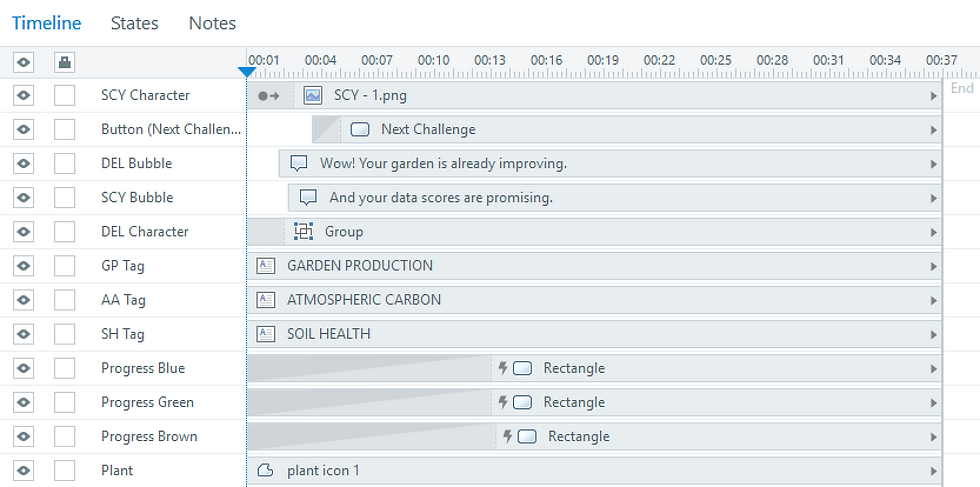
Development in Storyline 360: I built the simulation in Storyline, organizing objects on the timeline so animations stack logically and can be tuned quickly. Gamified meters track soil health, atmospheric carbon, and garden productivity as learners make choices.
CAN YOU REGENERATE YOUR SOIL?
Articulate Storyline 360 Script — Draft 1
Duration: ~10 minutes | Format: On-screen text with voiceover optional
Audience: Young/new farmers & climate-curious gardeners
OPENING SCENARIO: “From Dirt to Gold”
[Visual: A sad, garden. Soil is dry and cracked. A single plant droops.]
DEL (appears onscreen from left):
“Hey there! Your garden’s looking... well, let’s call it ‘soil-challenged.’ But don’t worry—we’ve all been there. You’re about to learn how to turn that dust bowl into soil gold.”
GREENHOUSE LAB: “SCIENCE OF SOIL”
SCY (enters from right):
“Indeed. Soil degradation isn’t just bad for plants—it releases carbon into the atmosphere. But good news: healthy soil draws it down. Let’s regenerate this garden—together.”
Your goal: Improve soil health, boost your garden’s resilience, and reduce atmospheric carbon using three core practices.
Let’s get to work.
[Gamification Progress Bar Activated: Soil Health | Atmospheric Carbon | Garden Productivity ]
CHALLENGE ONE: "DON'T FLIP OUT"
DEL:
“Okay, time to prep the soil... or is it? The ol’ dig-and-flip method might not be the best bet.”
SCY:
“Tilling exposes organic matter to oxygen, accelerating microbial respiration. That releases carbon rapidly—like setting the pantry on fire.”
Decision Point (Multiple Choice):
Visual Storyboard
A slide-by-slide storyboard helped the client see how narrative, data visualizations, and decision points would come together on screen. Each panel combines layout, dialogue, programming notes, and art direction to keep design and development aligned.


Development and Prototype
Using the storyboard and mockups, I built an interactive prototype in Storyline 360. Organizing elements into grouped layers allowed quick iteration on timing, animations, and feedback states. The current prototype is a fully functional 10-minute module ready for pilot testing and further refinement.

